
Documentary Photograph of Noah Webster Home before Dismantling and Relocation to Greenfield Village, 1936
THF236321 / Documentary Photograph of Noah Webster Home before Dismantling and Relocation to Greenfield Village, 1936
01
Artifact Overview
This is a detail of textbook pioneer and spelling reformer Noah Webster's home on its original site in New Haven, Connecticut. Henry Ford admired Webster and recognized his house as an important piece of American history. Ford had the building moved to Greenfield Village - his historical outdoor museum in Dearborn, Michigan. This view documents exterior decoration shortly before the move to Greenfield Village.
Artifact Details
Artifact
Photographic print
Date Made
1936
Subject Date
1936
Collection Title
Location
Not on exhibit to the public.
Object ID
EI.1929.405
Credit
From the Collections of The Henry Ford.
Material
Paper (Fiber product)
Technique
Gelatin silver process
Color
Black-and-white (Colors)
Dimensions
Height: 4.375 in
Width: 2.75 in
Keywords |
|---|
02
Related Artifacts
 Artifact
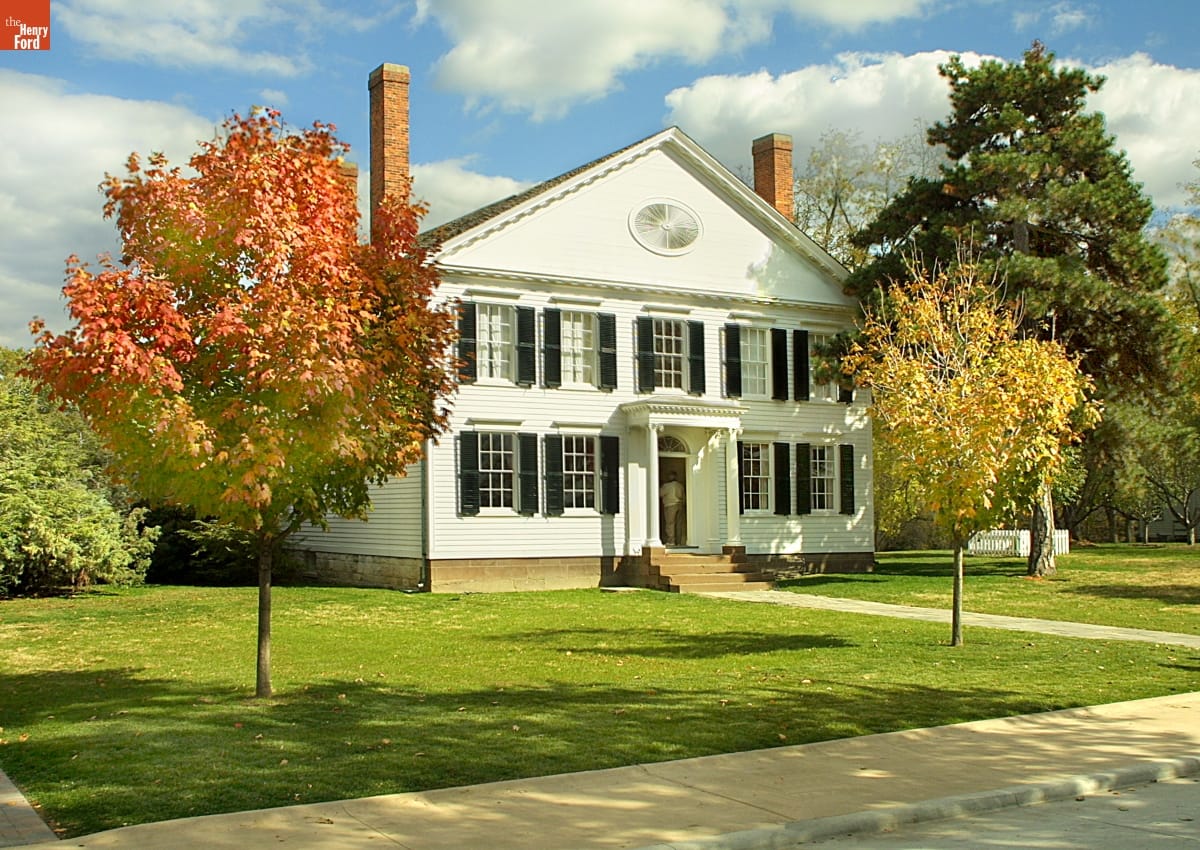
Noah Webster Home
Noah Webster and his wife Rebecca had this comfortable New Haven, Connecticut, home built in their later years to be near family and friends, as well as the library at nearby Yale College. While living in this house, Webster published his famous American Dictionary of the English Language in 1828. His dictionary aimed to capture distinctively American words and spellings for the first time.
03
Related Content
 article
An Ideal Place of Joy and Comfort: The Life of Lucy Griffin
Lucy Griffin was a free woman of color who, starting sometime in the early 1830s, resided with the Noah Webster family, kept house, and acted as caretaker for the Websters' youngest daughter, Louisa. article
Noah Webster’s Other Best Seller!
Many of us know that Noah Webster was the creator of the first American dictionary, published in 1828. But did you know that Mr. Webster was a teacher as well, and the author of the American Spelling Book?- article
Classical Details: A Close Look at the Noah Webster Home
Take a closer look at the architectural details of the 1820s Classical Revival Noah Webster Home in Greenfield Village—including Ionic columns, wooden mutules, and a louvered ellipse.