
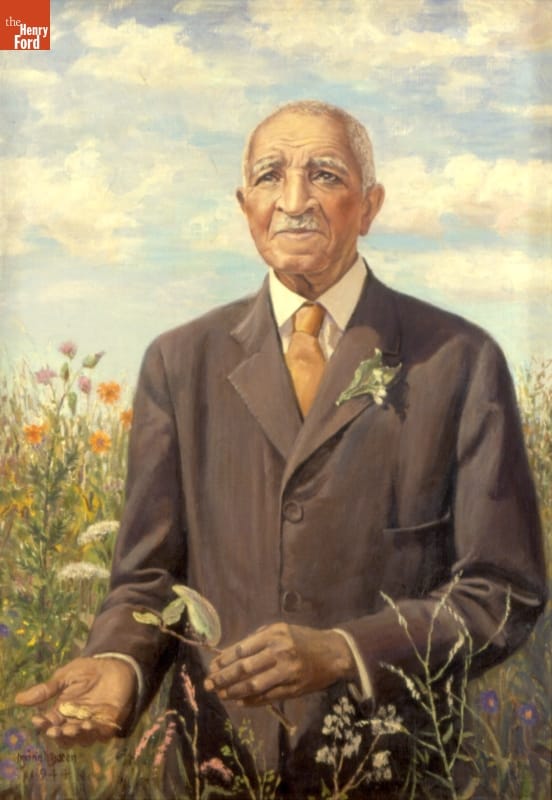
Portrait of George Washington Carver, 1944
THF253995 / Portrait of George Washington Carver, 1944
01
Artifact Overview
Henry Ford commissioned his personal artist, Irving Bacon, to paint a portrait of Ford's friend, the agricultural scientist George Washington Carver. Carver sat for the painting during his visit to Dearborn in 1942. This photographs documents the work. Carver, who loved plants, the soil, and farmers, is shown in a meadow wearing his customary old suit with boutonniere and holding a peanut and milkweed pod.
Artifact Details
Artifact
Photographic print
Subject Date
1944
Creator Notes
Original painting by Irving R. Bacon.
Collection Title
Location
Not on exhibit to the public.
Object ID
EI.1929.2870
Credit
From the Collections of The Henry Ford.
Material
Paper (Fiber product)
Technique
Gelatin silver process
Color
Black-and-white (Colors)
Dimensions
Height: 10.000 in
Width: 8.125 in
Keywords |
|---|
02
Related Artifacts
 Artifact
Portrait of George Washington Carver, 1944
Henry Ford commissioned his personal artist, Irving Bacon, to paint this portrait of Ford's friend, the agricultural scientist George Washington Carver. Carver sat for the painting during his visit to Dearborn in 1942. Carver, who loved plants, the soil, and farmers, is pictured in a meadow. He is wearing his customary old suit with boutonniere and is holding a milkweed pod and a peanut.
03
Related Content
 article
Healthy Food to Build Healthy Communities
Food security links nutritious food to individual and community health. Explore this concept through historical resources in the collections of The Henry Ford, including the work of African American scientist George Washington Carver. article
George Washington Carver’s Microscope
Take a closer look at Black empowerment through Black education with the microscope used by agricultural scientist George Washington Carver during his tenure at the Tuskegee Institute in Alabama.